

Financial Independence: When Money Finally Gives You the Freedom to Say No

It’s 7:04 on a Tuesday morning, and you’re sitting in a glass conference room at Renner Industrial, holding a paper cup of water nobody asked for. The regional manager is standing at the front explaining the company’s new attendance policy: mandatory Saturdays, two a month, starting in April. There are no exceptions for the parts counter. He says the word “unfortunately” three times in about 90 seconds, and there are 11 people sitting around the table listening to him.
You count them without meaning to. Ten of them are doing math in their heads right now. They’re thinking about daycare, second jobs, mortgages, car payments, and all the other obligations that depend on a certain number of working hours continuing to arrive every month. You can watch it happen from across the table, and from the outside it looks like absolutely nothing. It looks like adults listening politely to a manager explaining a new policy.
You’re the 11th person in the room, and you’re not doing the math because you don’t have any left to do.
Your badge says parts coordinator. It has said the same thing for seven years. Your car in the parking lot is a 2014 Corolla with 173,000 miles and a passenger door that only opens from the inside. Your jacket is from a company golf outing you didn’t even play in. Nothing about you suggests financial independence. Nothing about the way you dress, drive, or live would make someone assume that your accounts crossed $1,060,000 in March.
Nobody in this building would guess that. Not the regional manager. Not Cody, sitting two chairs down with his jaw already set because he knows exactly what two Saturdays a month means for him.
Here’s what it took you nine years to understand: financial independence has almost nothing to do with the number itself. The money matters, obviously, but the real value of reaching financial independence is what that money changes about your relationship with work, obligations, and other people’s authority over your time.
This new attendance policy isn’t really a policy to you. It’s a test of who can afford to argue. Almost nobody in this room can. That’s precisely why it’s going to pass, and the man at the front already knew it would before he printed the handout.
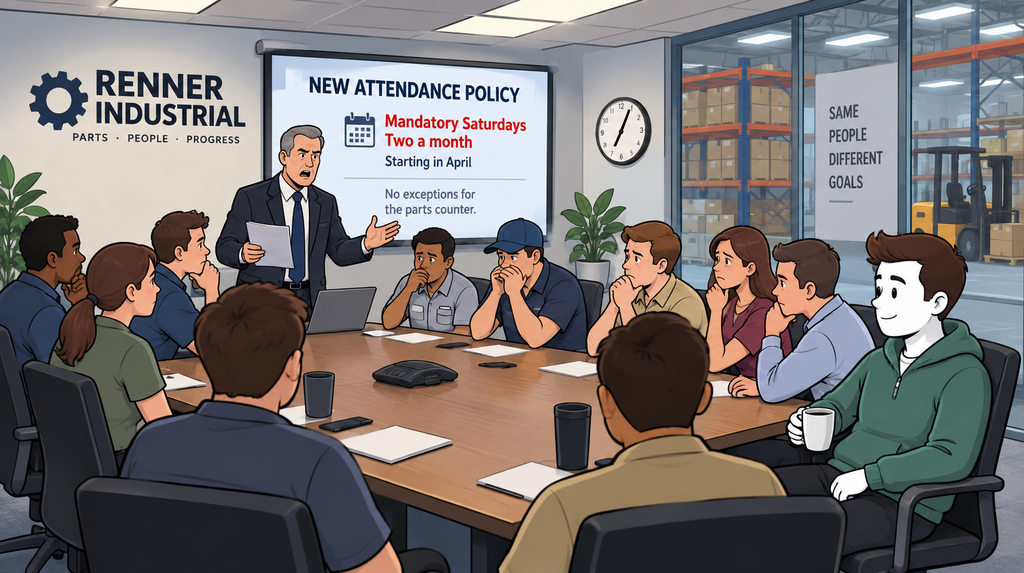
You could stand up right now and say what everyone else is thinking. There isn’t one consequence in this building that could reach you in a meaningful way. You could disagree, walk away, or simply say no. That’s what the money actually bought.
Not a luxury car. Not a mansion. Not an expensive vacation.
It bought you the ability to sit in a room like this one and not be moved by it.
What nobody warns you about, though, is what happens to a person after that becomes permanently true. After you stop being financially reachable. After the people around you can feel that you have options, even when they can’t understand why.
Because the same financial freedom that makes you harder to control can also make you, quietly, a little harder to love.
Nine Years Earlier, You Had Almost No Financial Freedom
Rewind nine years.
You’re 24 years old. You make $16.90 an hour pulling and staging orders at the same industrial supply company, and your paycheck lands every other Friday at around $1,190 after taxes. Rent is $840 for half a duplex with a heater that sounds like someone dropping a wrench. Insurance is $91. There’s $2,100 sitting on a credit card at 24.9% interest from a semester you didn’t finish and a laptop you no longer own.
Your checking account usually lives somewhere between $180 and $500.
In November, your supervisor asks you to work the day after Thanksgiving. Not asks, exactly. He stands at the end of the aisle and tells you the schedule is already up.
You say yes before he finishes the sentence.
That’s the detail you’ll think about years later.
Not that you worked the shift. Not that you spent the day after Thanksgiving at work. What stays with you is that your mouth said yes while the rest of you was still catching up. There was no real decision in there anywhere.
There wasn’t room for one.
In January, your landlord raises the rent by $95. You read the letter twice, put it on the counter, and start planning the extra shifts. You don’t call him. You don’t negotiate. What would you negotiate with? You don’t have enough financial room to make the conversation meaningful.
Cody starts the same month you do. Same wage, almost to the dollar. He’s easy to be around. He remembers birthdays, covers your shift when your sister is in the hospital, buys the first round every time, and waves you off whenever you try to pay him back.
Six months in, Cody leases a truck for $541 a month. It’s black, loud, and immaculate. He’s not reckless, and he’s not stupid. He works six days most weeks, and he wanted something at the end of those weeks that he could actually see. You don’t judge him for it. If your credit had gone through, you probably would have done something similar.
Then there’s Hollis.
Hollis drives the delivery route. He’s 63, wears the same canvas jacket in every season, and has probably said 40 words to you in an entire year. One afternoon, you’re both standing at the loading door waiting out a rainstorm. You make a joke about how you’d quit if you could ever afford to.
Hollis doesn’t laugh.
“Nobody owns you outright,” he says. “They just rent you, a month at a time.”
Then the rain stops, and he goes back to loading the truck.
You’re 24. You take it as an old man’s complaint.
It isn’t a complaint.
It’s a description.
It will take you most of a decade to understand the difference.
The First $40 Was the Beginning of Financial Independence
Three weeks later, you open a brokerage account on your phone while standing in the parking lot. You don’t use the break room because there are people in there and you don’t want to explain what you’re doing.
You set up an automatic transfer of $40 every payday into a broad index fund. You choose it because it is cheap and because someone on a forum said the boring one wins.
Forty dollars feels almost meaningless.
At the same time, that specific month, $40 is the difference between filling the tank and watching the fuel gauge all the way home.
The first transfer fails.
Insufficient funds by $6.
You feel the failure in your chest like a public embarrassment, even though the only two parties that know about it are you and a server somewhere. You change the transfer date so that it happens the day after payday instead of the same day.
The second transfer clears.
Nothing changes.
Your car still sounds the same. Your apartment still smells like the laundromat next door. You still say yes to every Saturday because $40 a payday does not buy you the right to say no to anything.
But something microscopic has moved.
The transfer now happens without an argument attached to it.
You’ve stopped negotiating with yourself twice a month.
By the end of that first year, the account holds $1,780.
You don’t tell anyone.
Not because it’s a secret. It’s because saying, “I have $1,780 in an index fund” doesn’t mean much to a 25-year-old sitting at a bar. Cody would probably ask why you’re not living your life. Your sister might ask if you can help with gas money, and she’d be right to ask. You’d say yes.
So you say nothing and keep going.
That is what the beginning of financial independence actually looks like for you. There is no dramatic breakthrough. No one congratulates you. There is no visible transformation. There is simply a small amount of money moving automatically in the same direction every payday.
How Small Investments Became Real Wealth
Two years pass.
You get a raise to $19.40 an hour, and you increase the automatic transfer to $85 before the first larger paycheck even lands. You never learn what the extra money feels like in your hands because you have already assigned part of it a purpose.
Then $19.40 becomes $22.15, and the transfer becomes $175.
You also pay off the $2,100 credit card in 14 months of overpayments.
There is no cinematic moment when the debt disappears. One Sunday, the balance is $63. The following month, it is zero. Then it stays zero. The only thing you notice is that a notification you had become accustomed to seeing simply stops arriving.
The investment account crosses $9,600.
Then $27,400.
You couldn’t identify the exact weekdays when those milestones happened if someone asked you later. Nobody clapped. There was nothing to announce.
That is what makes this part of building wealth genuinely difficult.
It doesn’t require extraordinary courage.
It requires doing something completely ordinary on schedule for years while having almost no evidence that it is working and nobody around you confirming that it is.
Cody upgrades too. His next truck costs him $694 a month. Then there’s a boat, which he uses four times the first summer and twice the second.
His income went up.
So did everything attached to it, slightly faster.
His money leaves his account on a schedule just like yours does. The difference is where it goes.
Neither of you ever says this out loud.
You simply make opposite decisions in the same parking lot for years.
Reaching $100,000 Changes the Psychology of Investing
You’re 29 when the account crosses $104,000.
It happens on a Sunday while you’re waiting for a pot to boil. You feel almost nothing, and that surprises you more than the number itself.
Six weeks later, the market drops 21%.
Your $104,000 becomes $82,300.
You watch the account in real time four or five times a day, which is its own kind of confession. Your hands actually go cold the first morning you see the loss as a percentage rather than a dollar figure.
Somehow, the percentage feels worse.
It feels like a verdict.
Cody asks if you’re getting wrecked out there, the way people ask about whether you live somewhere with real winters.
You tell him you’re fine.
You’re mostly fine.
But now you have a decision to make.
You run the version where you sell everything and move it to cash. You imagine how much better you would sleep if the bleeding stopped.
On the other side of that decision is the same person you were at 24: dependent on Friday’s paycheck, dependent on your supervisor, dependent on the schedule, dependent on being able to keep saying yes.
You didn’t start investing because you wanted to become rich.
You started because Hollis, standing in a wet canvas jacket at a loading door, told you what your life actually was.
You didn’t want it to be true forever.
Selling wouldn’t simply cost you money.
It would cost you the exit you had spent years building.
So you don’t sell.
More importantly, you keep investing $175 every payday into an asset that appears to be worth less every week you feed it.
It feels like lighting money on fire.
It turns out to be the opposite.
Eleven months later, the account isn’t back at $104,000.
It’s at $131,000.
The shares you bought while your hands were cold turned out to be some of the cheapest shares you’d purchased in years.
You didn’t feel brave.
You felt sick.
Nobody tells you those two feelings can look identical from the inside.
Financial Independence Changes How You See Monthly Payments
You’re 31 when the truck almost happens.
Your Corolla has reached 141,000 miles and starts making a noise on cold mornings that you know in your body is expensive.
A lot at the edge of town has a three-year-old pickup. Low miles. Clean.
The price is $38,400.
Financed out, it’s $624 a month.
You can afford it comfortably. Nobody at Renner would blink. Nobody in your family would say a word.
You keep the browser tab open for two days.
Then you run one more calculation.
$624 a month invested instead, using a long-run average that nobody can promise you, could become somewhere north of half a million dollars over 25 years.
It isn’t guaranteed.
It won’t move in a straight line.
But the shape of the calculation is enough.
You close the tab.
You don’t do it because trucks are irresponsible. Cody’s truck hasn’t ruined his life. You close the tab because you finally understand what a $624 monthly obligation actually represents.
It’s a promise you make on a Tuesday that you’ll continue showing up for 72 months.
No matter who your supervisor is.
No matter what the new policy says.
No matter how the room feels.
The truck isn’t just a truck.
It’s another obligation that limits your future choices.
And that’s one of the less obvious ways financial independence changes your relationship with money. You stop looking at monthly payments only as prices. You start seeing the commitment attached to them.
When Your Money Starts Working Beside You
You’re 33 when you finally start looking at the entire year instead of individual paychecks.
You’re sitting at the kitchen table on a weeknight and add everything together.
Your contributions that year were $9,100.
The account’s growth was $27,300.
You check the calculation twice because the first result looks like a typo.
Three times what you put in.
It didn’t come from a raise.
It didn’t come from overtime.
It didn’t come from some clever financial trick.
And it definitely didn’t feel like it happened quickly.
You started at 24 with $40 and a failed transfer.
For nine years, you were the only engine.
Now there is a second one.
It doesn’t need a schedule.
It doesn’t ask for a Saturday.
It doesn’t have to be polite to anyone sitting in a glass conference room.
That is the point where wealth begins to feel different.
You are still working.
You are still earning.
But your labor is no longer the only thing producing financial progress.
The Six Words That Changed Everything
That November, your supervisor puts you down for the holiday shift again.
Same aisle.
Same posture.
“Schedule’s already up.”
And you hear yourself say, “I’m not available that day.”
Six words.
No excuse.
No elaborate explanation.
You simply aren’t available.
Halfway through the sentence, you realize something important.
You don’t need an excuse.
Your supervisor blinks.
Then he says fine. He’ll move it.
He does.
That’s the entire scene.
Nothing dramatic happens.
You go home and sit in your car in your own driveway for a minute with the engine off. It takes you a while to understand why your heart is beating so hard.
On paper, nothing happened.
You simply declined a shift.
You’ve worked nine years for those six words.
Not for a new car.
Not for a vacation.
For the ability to say no without immediately calculating what saying no might cost you.
Financial Security Gives You Options During Emergencies
At 34, the pipe above the utility room lets go on a Saturday.
Water reaches the drywall before you notice it.
After insurance decides which half it will cover, the bill comes to $2,780.
You transfer the money.
You don’t open a second account first to see whether you can afford it.
You don’t stand in the hallway doing arithmetic in your head.
You already know.
Nadia is there when the plumber gives you the estimate. You’ve been together for about a year. She works scheduling at a dental group, drives a Camry older than yours, and is completely unembarrassed about it.
She watches you say, “Go ahead and hang up.”
“You didn’t even pause,” she says.
You tell her that you used to pause at $200.
She doesn’t ask the bigger question that night.
She waits eight months.
Then she asks it.
Wealth Can Also Give Other People an Exit
At 35, your sister calls at 11 on a Thursday.
Her landlord isn’t renewing her lease. She needs first month’s rent, last month’s rent, and a deposit within three weeks.
She’s laughing while she explains it, which is how you know she’s scared.
You send her $3,400 that night.
No terms.
No spreadsheet.
No repayment schedule.
You never bring it up again.
When she tries to, twice, you change the subject until she eventually stops.
The money doesn’t move your net worth in any way you’d notice on a statement.
But it changes something else.
A man who wanted something from your sister no longer gets to control her through the threat of housing instability.
That’s another thing money can do.
It doesn’t only buy comfort.
Sometimes it buys people out of other people’s leverage.
Financial Independence Means You Can Turn Down the Bigger Paycheck
At 36, the district job opens.
It pays $17,500 more a year.
It comes with a title that carries weight.
It also requires relocating 90 minutes east, and the relocation isn’t really presented as optional.
Three years earlier, you would have said yes at the end of the aisle.
You would have taken a week to think about it.
Now you run the numbers once.
The portfolio is at $418,000 and, on a conservative read, is producing something close to $16,700 a year on its own.
You aren’t withdrawing that money.
You’re not spending it.
It simply exists whether you get out of bed or not.
You turn the job down.
Your manager tries twice, in two different ways.
The second version is closer to, “What do you want, then?”
The honest answer is nothing you have.
That’s the sentence you never say out loud.
You can’t necessarily be paid enough to do something you no longer need the money for.
And you can’t be threatened with something you know you can survive.
From a management perspective, you’ve quietly stopped having handles.
The Unexpected Cost of Financial Freedom
You’re 37 the first time it stops being personal.
The company introduces a scheduling change that lands heavily on hourly workers, the people with the least financial room and the fewest alternatives.
Fourteen people are in the room.
Every one of them can do the math in about four seconds.
Nobody says anything.
Not because they agree.
Because saying something has a price, and they don’t have the money to pay it.
You say something anyway.
Plainly.
Without anger.
You explain who the change will actually affect and what it will do to the third shift by August.
The room becomes very quiet.
Two weeks later, the policy is softened.
Not completely fixed.
Softened.
It’s described as something management had already been reconsidering.
Two coworkers thank you separately in the parking lot.
They don’t want to be seen thanking you together.
From that day forward, you’re handled differently.
Not necessarily punished.
Managed.
Looped in later.
Your performance review describes you as someone with “strong opinions.”
It isn’t meant as a compliment.
Because a person who cannot easily be moved is not always convenient in a room built around moving people.
You assumed financial freedom would make you more useful.
Instead, it made you less convenient.
Nobody tells you about that trade before you become financially independent.
The Emotional Cost of Becoming Financially Independent
It gets quiet.
Not sad.
Quiet.
Cody stops asking you to cover shifts because you’ve said no twice. Without ever discussing it, he decides what kind of person you’ve become.
He’s wrong.
You probably would have said yes if he’d asked differently.
But there’s no perfect version of that conversation waiting for you on a Friday afternoon.
An old friend borrows $2,000, pays back $900, and disappears on the remaining balance.
You don’t bring it up.
Ever.
Something between you still cracks.
Thin and permanent.
Like a windshield.
Your mother stops telling you when things go wrong because she’s noticed that you fix them.
And being the person who can always fix things has a cost.
You spend a decade becoming financially independent so that you don’t have to lean on anyone.
Eventually, people stop leaning.
And the space where they used to lean is simply space.
Nadia says it best eight months after the plumber, on a Sunday.
“You’ve gotten very hard to worry about.”
She doesn’t mean that you’re cold.
She means that worry is one of the ways people hold each other.
You’ve quietly removed yourself from that exchange.
There’s nothing anyone can carry for you.
There’s no favor big enough to matter.
When Saying No Becomes a Habit
Around $700,000, you notice something else.
You’ve started saying no to things you don’t actually mind.
A committee.
A weekend favor.
A conversation that would cost you almost nothing.
You say no because you can.
And somewhere along the way, refusing has stopped being freedom and started becoming a habit wearing freedom’s jacket.
Being uncontrollable isn’t the same thing as being good.
One of those is simply easier.
Then there’s the fear nobody talks about because it doesn’t make sense on paper.
At $27,000, losing your savings would have hurt.
At $1 million, losing it would mean something different.
It would mean returning to the version of yourself who says yes before his mouth catches up.
Some nights, at two in the morning when nothing is wrong, you imagine that scenario.
You see yourself back at the end of the aisle.
Waiting for someone else to decide what happens next.
Hollis Was Right All Along
You see Hollis at a hardware store the spring you turn 38.
He’s 66.
Still driving the route.
You tell him, awkwardly, what he said at the loading door all those years ago.
He remembers saying it.
He doesn’t remember saying it to you.
Then he tells you something you aren’t ready for.
He knew it at 30.
He never did anything about it.
He wasn’t broke.
He was fine.
He was just always three or four years away from the version of himself who would finally start.
Then the years ran out of room.
“I said it to you,” he tells you, “because I’d already lost that argument with myself.”
You buy the furnace filters.
Then you sit in the Corolla in the parking lot for a while.
It changes what you thought the story was.
You didn’t inherit wisdom from a man who had won.
You were handed a warning by a man who understood the mechanism perfectly and never managed to escape it.
That’s most people.
That’s almost everyone.
Knowing isn’t the part that saves you.
$1.124 Million and a Different Relationship With Work
It’s 7:04 on a Tuesday morning at Renner Industrial.
You’re back in the same glass conference room with another paper cup of water nobody asked for.
Different manager.
Different policy.
More or less the same handout.
Eleven people.
Ten of them doing math.
Cody is two chairs down.
Third truck now.
And he’s fine.
Genuinely fine.
He’s not a cautionary tale. He’s simply a man living inside the trade-offs he made, just as you’re living inside yours.
The difference is that he has to be here.
You don’t.
Your accounts read $1,124,000 as of last night.
You looked at the number once, in the dark, the way you’d check whether it rained.
You could have left two years ago.
You stay because, on most days, the work is fine.
The drive is only 11 minutes.
And there is a specific pleasure in walking into a building that has no idea what it’s looking at.
You’re the only person in the room who isn’t quietly calculating what it costs to disagree.
Everyone can feel that about you without being able to explain why.
Hollis was right.
It took you nine years in a hardware store aisle to understand what he meant.
Nobody owns you outright.
They just rent you, a month at a time.
Every obligation you sign is a renewal.
Every payment you can’t miss is a month you have already sold.
You simply stopped renewing.
That was all it ever was.
Not a windfall.
Not a stock pick.
Not some overnight transformation.
It was $40 a payday, one failed transfer, and a decade of Tuesdays that looked exactly like this one.
The meeting ends.
Everyone stands.
You put the paper cup in the bin by the door and walk back to the counter.
And for a moment, the entire journey is contained in that ordinary walk.
What Financial Independence Really Gives You
Financial independence is often described through numbers: net worth, investment returns, savings rates, passive income, or the amount of money needed to retire.
But those numbers only describe the outside of the story.
The inside is different.
The inside is the first time you can say no without panic.
It’s the first emergency bill that doesn’t require a crisis.
It’s the first job opportunity you can evaluate based on the life it creates rather than only the salary it offers.
It’s being able to help someone you love without putting your own financial stability at risk.
It’s knowing that if the person sitting across from you changes the rules, you still have choices.
The money doesn’t make you immune to consequences.
It gives you alternatives.
That’s why the first $40 mattered.
It wasn’t because $40 could make you financially independent by itself.
It mattered because it represented the first decision in a long chain of decisions that slowly reduced your dependence on a paycheck.
The account grew.
The debt disappeared.
The market crashed.
You kept investing.
You avoided obligations that would have limited your options.
Your income increased.
Your investments began contributing alongside your labor.
Eventually, the money became large enough that the relationship changed.
You weren’t simply working for money anymore.
Money was beginning to work alongside you.
And eventually, it gave you something more valuable than the ability to buy things.
It gave you the ability to choose.
The Real Meaning of Financial Freedom
Maybe that’s what financial independence actually means.
Not that you never work again.
Not that you own the biggest house.
Not that you drive the newest truck.
Not that you have more money than everyone around you.
And certainly not that every problem disappears.
Financial freedom means that money no longer automatically makes every decision for you.
You can stay because you want to stay.
You can leave because you need to leave.
You can disagree without immediately calculating the consequences.
You can help someone without destroying yourself.
You can absorb an unexpected bill without feeling the floor disappear beneath you.
You can look at a monthly payment and understand that you’re not just buying an object.
You’re committing future time.
And perhaps most importantly, you can finally understand what Hollis meant.
Nobody owns you outright.
They just rent you, a month at a time.
Every obligation is a renewal.
Every payment you can’t miss is a month you’ve already sold.
The journey toward financial independence doesn’t always look impressive while you’re living it.
Sometimes it looks like a 24-year-old standing in a parking lot, setting up a $40 automatic transfer.
Sometimes it looks like a failed transaction.
Sometimes it looks like keeping an old Corolla.
Sometimes it looks like watching $104,000 become $82,300 and refusing to panic.
Sometimes it looks like closing a browser tab on a $38,400 truck.
Sometimes it looks like saying six words to a supervisor:
“I’m not available that day.”
And sometimes, years later, it looks like sitting in a glass conference room while everyone else calculates what disagreement might cost them.
You don’t have to calculate it anymore.
That is what the money bought.
Not a better life in every possible sense.
A life with more choices.
And the ability to decide what happens next.
If this changed how you think about the difference between earning money and becoming financially independent, consider what that freedom would actually mean in your own life.
Not the number.
Not the account balance.
Not the car.
Not the house.
The decision.
What’s the one thing in your life right now that you’d say no to immediately if money weren’t attached to it?
That’s the question worth sitting with.
Because financial independence isn’t ultimately about having enough money to buy everything you want.
It’s about having enough financial security that money stops making every important decision for you.
And sometimes, after years of saving, investing, sacrificing, and waiting, the most valuable thing your money can buy is simply the ability to say:
No.
And mean it.
