

50/30/20 Budget Rule: How to Manage Money Smartly

Do you ever feel like your paycheck disappears faster than expected? You pay rent, buy groceries, cover utility bills, and handle everyday expenses. Before you know it, there is very little money left for savings or the financial goals you want to achieve.
If this sounds familiar, you are not alone. Managing money can feel complicated when you have several financial responsibilities and no clear plan for dividing your income.
The good news is that budgeting does not have to involve complicated spreadsheets or tracking every dollar throughout the day. A simple strategy called the 50/30/20 budget rule can help you organize your money, control spending, and build better financial habits.
The idea is straightforward: allocate 50% of your take-home income to needs, 30% to wants, and 20% to savings and additional debt repayment. This framework gives your money three clear purposes, helping you balance current expenses with future financial security.
Whether you are a college graduate managing your first full-time paycheck, a family trying to control household expenses, or someone who wants to save more consistently, this budgeting method can provide a useful starting point.
In this guide, you will learn how the 50/30/20 budget rule works, how to calculate your monthly allocations, which expenses belong in each category, and how to adapt the method to your actual financial situation.
What Is the 50/30/20 Budget Rule?
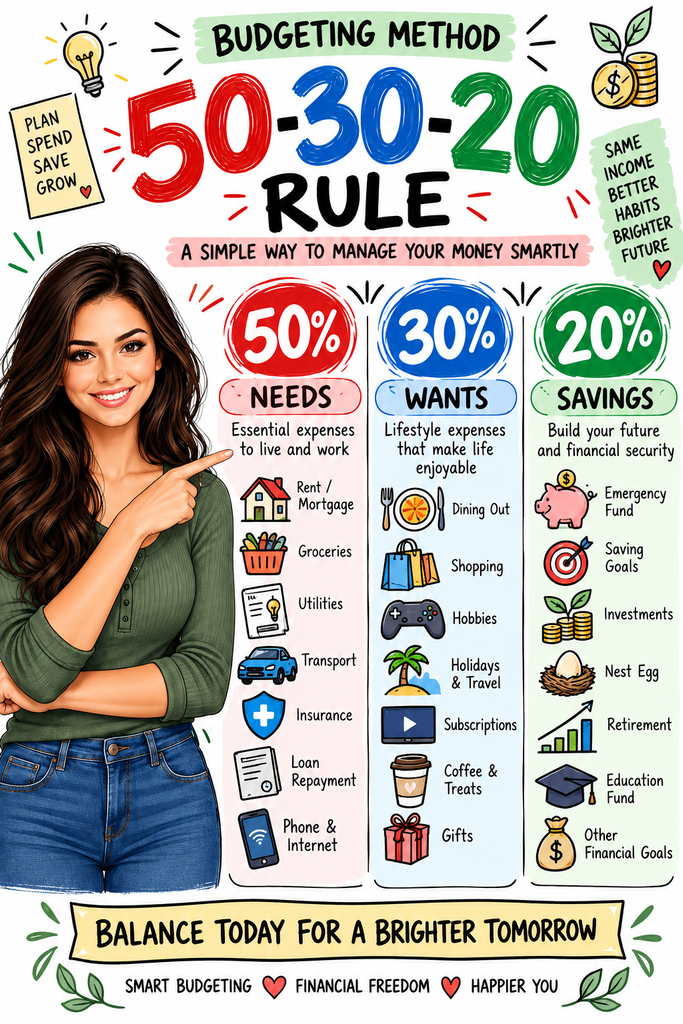
The 50/30/20 budget rule is a personal finance strategy that divides your after-tax income into three main categories.
- 50% for needs: Essential expenses required to maintain your household and meet basic obligations.
- 30% for wants: Optional purchases and lifestyle expenses that improve your quality of life.
- 20% for savings and debt goals: Emergency savings, retirement contributions, financial goals, and additional debt repayment.
The framework is designed to make budgeting easier by grouping expenses into broad categories rather than requiring dozens of separate spending limits. The Consumer Financial Protection Bureau also presents this type of percentage-based budget as a useful rule of thumb, while emphasizing that individuals can develop a personal spending plan suited to their circumstances. Source: CFPB budgeting guidance.
How Does the 50/30/20 Rule Work?
Imagine you bring home $4,000 every month after taxes and payroll deductions.
Using the traditional 50/30/20 allocation, your budget would look like this:
| Budget category | Percentage | Monthly amount |
|---|---|---|
| Needs | 50% | $2,000 |
| Wants | 30% | $1,200 |
| Savings and debt goals | 20% | $800 |
| Total | 100% | $4,000 |
This example gives you a clear starting point for deciding how much to spend, how much to enjoy, and how much to save.
However, these percentages are guidelines rather than strict requirements. If your rent, healthcare, childcare, or transportation costs are high, you may need to spend more than 50% on necessities. The purpose is to create a realistic budget that improves your financial decisions, not to force your expenses into percentages that do not fit your life.
1. Allocate 50% of Your Income to Needs
The first part of the 50/30/20 budget rule focuses on necessities. These are expenses you must pay to maintain a reasonable standard of living and meet important financial obligations.
Your needs category should cover the essential costs that would be difficult to eliminate without affecting your housing, health, work, or daily responsibilities.
What Counts as a Need?
Common essential expenses include:
- Rent or mortgage payments
- Groceries and basic household supplies
- Electricity, water, and heating
- Essential internet and mobile phone service
- Health insurance and necessary medical expenses
- Transportation needed to get to work
- Car insurance and essential vehicle maintenance
- Minimum required debt payments
- Childcare necessary for work or education
For example, if you earn $4,000 per month after taxes, your target for needs would be $2,000.
You might allocate $1,200 to housing, $350 to groceries, $150 to utilities, $150 to transportation, and $150 to insurance and other essential costs. These expenses total $2,000.
Actual costs vary significantly by household, location, and family size, so use your own bills when creating your budget.
How to Keep Essential Expenses Under Control
Housing is often one of the largest household expenses. If rent or mortgage payments consume most of your income, it becomes harder to follow the traditional 50% target.
Start by reviewing your largest recurring expenses rather than trying to eliminate every small purchase.
Consider comparing insurance policies, reducing utility waste, planning meals before grocery shopping, and reviewing mobile phone plans. If your housing costs are consistently too high, explore realistic options when your lease or other circumstances allow.
Do not cut essential medical care, adequate insurance, nutritious food, or other necessary expenses simply to meet a percentage.
Practical tip: Review three months of bank statements to understand your actual spending. Include less frequent necessities, such as annual insurance premiums and routine car maintenance, so your budget reflects the full cost of living.
2. Use 30% for Wants and Enjoy Life Without Overspending
A successful budget should not leave you feeling that every enjoyable activity is off-limits. The second part of the 50/30/20 budgeting method reserves 30% of take-home income for wants.
Wants are purchases that make life more comfortable or enjoyable but are not essential to meeting your basic needs.
Examples of Wants
Your wants category might include:
- Restaurant meals and takeout
- Coffee from your favorite café
- Streaming subscriptions
- Concerts and entertainment
- Vacations and leisure travel
- Hobbies and recreational activities
- Nonessential clothing and accessories
- Upgrades to electronics or household items
- Premium services you could live without
If your monthly take-home income is $4,000, the 30% target gives you $1,200 for these expenses.
This does not mean you must spend the entire amount. If you enjoy inexpensive activities or prefer a simpler lifestyle, you can direct some of the money toward additional savings instead.
Understand the Difference Between Needs and Wants
Some expenses can fall into either category depending on your circumstances.
For example, a basic phone plan may be essential for work, while a more expensive plan with extra features may represent a want. Basic groceries are necessary, but frequent premium takeout meals are generally discretionary.
A car might be essential if you need it to commute in an area without reliable public transportation. However, upgrading to a more expensive vehicle than you need may be a lifestyle choice.
The key question is whether the expense is necessary or whether a less expensive alternative could reasonably meet the same need.
How to Control Discretionary Spending
Start by identifying purchases that provide genuine value to you. You do not have to remove every subscription or stop enjoying meals out.
Instead, set spending limits that reflect your priorities. For instance, you might allocate a portion of your wants budget to dining, another portion to entertainment, and the remainder to hobbies or shopping.
Try waiting 24 hours before making nonessential purchases you had not planned for. This simple pause can help you distinguish between something you genuinely want and something you are buying impulsively.
Practical tip: Give yourself permission to enjoy your money within a defined limit. A sustainable budget should support both your financial future and your present quality of life.
3. Save 20% of Your Income for Financial Security
The final 20% of the traditional 50/30/20 budget rule focuses on savings and financial progress. This category helps you prepare for unexpected expenses, reduce debt faster, and work toward future goals.
Saving consistently can be challenging, especially when you have multiple responsibilities. Setting a percentage-based target gives you a clear starting point and encourages you to treat saving as a planned expense.
If your monthly take-home pay is $4,000, your target for this category is $800.
What Should Your 20% Include?
Depending on your circumstances, you might divide this portion among:
- Emergency fund contributions
- Retirement savings
- Additional payments toward high-interest debt
- Savings for a home deposit
- Education or professional development
- Other medium- and long-term financial goals
The exact allocation depends on your priorities. Someone without emergency savings may focus on building a cash reserve, while someone with a high-interest credit card balance may direct more money toward repayment.
Minimum required debt payments generally belong in the needs category. Additional payments intended to reduce debt faster can be tracked in the savings and debt-goal category, provided your budget classifies them consistently.
Build an Emergency Fund First
An emergency fund can help cover unexpected expenses such as urgent home repairs, necessary car repairs, or a temporary loss of income.
A common longer-term goal is to save three to six months of essential living expenses, although the appropriate amount varies according to income stability, household obligations, and access to other financial resources.
If that target feels too large, start with a smaller milestone. Even a modest reserve can provide a starting point for building financial resilience.
Keep emergency savings accessible in an appropriate deposit account, and compare fees, interest rates, and account terms before opening one.
Make Saving Automatic
One of the easiest ways to improve consistency is to schedule automatic transfers after payday.
For example, if your monthly take-home income is $4,000, you could automatically move $400 into emergency savings and allocate another $200 to retirement savings and $200 to additional debt repayment or another financial goal.
This is only an illustration; the appropriate division depends on your existing savings, employer retirement benefits, debt interest rates, and other financial needs.
If your employer offers a retirement plan with matching contributions, review the plan’s eligibility rules and matching terms. Employer matching can be an important consideration when deciding how to prioritize retirement contributions.
Practical tip: Save what you can consistently afford. If 20% is currently unrealistic, begin with a smaller amount and increase it when your financial situation improves.
4. How to Calculate Your 50/30/20 Budget
Now that you understand the three categories, it is time to build your own monthly budget.
You do not need advanced financial knowledge to get started. A calculator, spreadsheet, budgeting app, or notebook can help you organize the numbers.
Step 1: Calculate Your Take-Home Income
Use the money you actually have available after taxes and payroll deductions, rather than your gross salary.
For salaried employees, this usually means the amount deposited into your bank account. If your employer deducts retirement contributions or health insurance premiums before your paycheck reaches you, remember that those amounts may already be supporting savings or essential expenses.
Avoid counting them twice.
If you are self-employed or work as a freelancer, estimate income after setting aside appropriate amounts for taxes and necessary business expenses. Because income can fluctuate, use a conservative estimate and review your budget regularly.
Step 2: Multiply Your Income by Each Percentage
The calculations are simple:
- Needs target = monthly take-home income × 0.50
- Wants target = monthly take-home income × 0.30
- Savings target = monthly take-home income × 0.20
For example, if your take-home income is $3,200:
| Category | Calculation | Monthly target |
|---|---|---|
| Needs | $3,200 × 0.50 | $1,600 |
| Wants | $3,200 × 0.30 | $960 |
| Savings and debt goals | $3,200 × 0.20 | $640 |
| Total | $3,200 |
You can use the same calculation regardless of whether you receive $2,500, $3,200, or $6,000 per month.
Step 3: Compare Your Targets With Actual Expenses
List your current spending under the three categories.
Compare the actual amounts with your targets to identify where adjustments may be possible.
If your needs total $1,900 but your target is $1,600, investigate whether the difference comes from unavoidable housing costs, rising insurance premiums, or expenses that might be reduced.
If your wants exceed $960, identify the discretionary categories with the greatest potential for adjustment.
If you are saving less than $640, review whether there is room to increase contributions without compromising essential expenses.
The Consumer Financial Protection Bureau recommends examining actual spending, including irregular costs, and comparing your budget with your take-home pay. Its spending assessment guidance provides a useful starting point.
Step 4: Automate and Review
Once your budget is realistic, schedule transfers and bill payments where appropriate.
Review your progress at the end of each month. Your first budget will rarely be perfect, and that is normal.
Update the numbers when rent changes, your income increases, you pay off debt, or your family responsibilities change.
5. Real-Life 50/30/20 Budget Example
Consider a household with $5,000 in monthly take-home income.
Under the traditional budget rule, the household would allocate $2,500 to needs, $1,500 to wants, and $1,000 to savings and debt goals.
Here is one possible breakdown:
| Expense or goal | Monthly amount |
|---|---|
| Needs | |
| Rent or mortgage | $1,400 |
| Groceries | $400 |
| Utilities and phone | $200 |
| Transportation | $250 |
| Insurance and other essentials | $250 |
| Total needs | $2,500 |
| Wants | |
| Dining out | $250 |
| Entertainment and subscriptions | $150 |
| Shopping and hobbies | $300 |
| Travel and leisure fund | $400 |
| Other discretionary spending | $400 |
| Total wants | $1,500 |
| Savings and debt goals | |
| Emergency fund | $300 |
| Retirement savings | $400 |
| Additional debt repayment or other goals | $300 |
| Total savings and debt goals | $1,000 |
| Grand total | $5,000 |
This example demonstrates how the method can turn a monthly paycheck into a structured spending plan.
Your own budget may look quite different. For example, a family paying high childcare costs might need to allocate more than 50% to necessities and reduce discretionary spending. Someone living with family may have lower housing costs and be able to save more than 20%.
Use the table as a model for organizing your finances rather than a standard every household must follow.
6. What If You Cannot Follow the 50/30/20 Rule?
One of the biggest misconceptions about budgeting is that everyone should be able to meet the same percentages immediately.
In reality, rent, healthcare, childcare, transportation, and debt obligations can consume a large share of take-home income. The Consumer Financial Protection Bureau explicitly recognizes that common budgeting rules may not fit everyone’s circumstances and encourages people to establish a personal spending rule that works for them.
If your essential expenses exceed 50%, you can still use the underlying principles.
Try a Flexible Budget
Suppose your take-home income is $3,000 and your essential expenses total $1,950.
That means your needs account for 65% of your income, leaving $1,050 for wants and savings.
Instead of forcing your necessities below $1,500 immediately, you could begin with a temporary 65/15/20 allocation:
- 65% for needs: $1,950
- 15% for wants: $450
- 20% for savings and debt goals: $600
This example assumes your actual expenses allow you to allocate the remaining amounts in that way. If your essential bills leave too little for both savings and wants, a different temporary split may be more realistic.
The important point is to understand your current financial position and make deliberate decisions about the money available.
Focus on Progress Instead of Perfection
If you cannot save 20% today, start with a smaller, sustainable contribution.
Review your largest expenses and identify changes that could improve your cash flow over time. You might also direct a portion of future pay increases toward savings rather than allowing all additional income to become new spending.
Avoid using additional borrowing simply to make your budget appear balanced.
A realistic budget that you follow consistently is more useful than a perfect-looking budget that does not reflect your actual life.
7. Common Mistakes to Avoid With the 50/30/20 Budget Rule
The 50/30/20 budgeting method is simple, but a few common mistakes can make it less effective.
Using Gross Income Instead of Take-Home Pay
Calculate your percentages using the appropriate available income figure. For most employees, that means after-tax take-home pay, with care taken to account for relevant payroll deductions and contributions correctly.
Treating Wants as Needs
It is easy to classify every familiar expense as essential. Review whether a lower-cost alternative could meet the same requirement without harming your health, safety, or ability to work.
Forgetting Irregular Expenses
Car registration, annual insurance, school supplies, gifts, and seasonal costs can disrupt a budget when they are ignored. Review several months of transactions and plan for known upcoming expenses.
Saving Only at the End of the Month
When saving depends entirely on leftover money, it can become inconsistent. If your budget allows, automate a contribution around payday.
Ignoring High-Interest Debt
Building savings is important, but expensive debt can also undermine financial progress. Consider your interest rates, minimum payments, available emergency cash, and other obligations when deciding how to divide your financial goals.
Never Updating Your Budget
Your budget should change as your circumstances change. Review it regularly and adjust your categories when necessary.
8. Your Simple 30-Day Plan to Start Budgeting
If you are new to budgeting, a short implementation plan can make the process easier.
Week 1: Understand your money. Calculate your take-home income and review recent bank statements. List essential bills, discretionary spending, debts, and savings contributions.
Week 2: Build your 50/30/20 budget. Calculate your initial targets and compare them with your real expenses. Adjust the percentages if the traditional split does not fit your circumstances.
Week 3: Set up your system. Create budgeting categories, schedule suitable automatic transfers, and establish reminders for upcoming bills.
Week 4: Review and improve. Compare your actual spending with your plan. Identify one or two changes that are realistic for the following month.
At the end of the first month, celebrate progress that is measurable: fewer unplanned purchases, a clearer picture of your expenses, or a consistent savings contribution.
You do not need to transform your entire financial life in a single month. Small improvements can help you build a more sustainable system over time.
Frequently Asked Questions About the 50/30/20 Budget Rule
Is the 50/30/20 budget rule good for beginners?
Yes. Its three broad categories make it relatively easy to understand and apply. Beginners can use it to identify spending priorities without tracking dozens of individual categories. However, the percentages should be adjusted when necessary.
Should I use my gross income or net income?
The traditional method uses after-tax take-home income. If retirement contributions or insurance premiums are deducted from your paycheck before deposit, account for those deductions carefully so that your budget does not count the same money twice.
Does the 20% savings category include debt repayment?
It can include additional debt payments beyond the minimums, along with emergency savings, retirement contributions, and other financial goals. Minimum required debt payments are generally treated as needs. Use a consistent approach when categorizing your expenses.
Can I save more than 20% of my income?
Yes. If your essential costs are manageable and your financial priorities allow it, saving more than 20% can help you reach your goals sooner. You can reduce discretionary spending or direct part of an income increase toward savings.
What if my rent alone uses more than 30% of my income?
The rule is a guideline, not a housing affordability test. Your actual housing costs depend on your location, income, and household needs. Focus on covering essential expenses, avoiding unsustainable debt, and finding realistic opportunities to improve your budget over time.
How often should I review my budget?
Review your transactions weekly if that helps you stay on track, and complete a broader monthly review. Revisit your percentages when your income, expenses, debt, or financial priorities change.
Final Thoughts: Make Your Money Work With a Clear Plan
The 50/30/20 budget rule offers a straightforward way to organize your money without turning budgeting into a complicated daily task.
By allocating income to needs, wants, and savings, you can gain a clearer understanding of your spending, make more intentional purchases, and create a practical path toward financial security.
Start by calculating your take-home income and reviewing your actual expenses. Use the traditional percentages as an initial guide, then adjust them to reflect your household’s needs and financial goals.
If you can save 20% today, build a consistent habit. If you cannot, start with an amount you can sustain and work toward improvement as your circumstances allow.
Your first step is simple: write down your monthly take-home income, calculate the three target amounts, and compare them with your current spending.
A useful budget is not about following percentages perfectly. It is about understanding where your money goes and making choices that support both your present needs and your future goals.
Disclaimer: This article is for general educational purposes and is not individualized financial, investment, or tax advice. Consider your personal circumstances when making financial decisions.