

How to Create and Sell Digital Products With AI: A Step-by-Step Guide

Artificial intelligence has changed the way digital products can be researched, created, packaged, marketed, and delivered. What once required days or weeks of writing, designing, and building sales systems can now be accelerated with AI-powered tools.
One approach gaining attention is the creation of simple digital products such as PDF eBooks, guides, checklists, worksheets, templates, and educational resources. The basic idea is straightforward: identify a problem people want to solve, create a useful digital resource around that problem, package it professionally, and build a system that makes purchasing and delivery easier.
The process described in the source material begins with identifying topics people are already interested in and then using AI to turn those interests into specific digital product concepts. It then moves through AI-assisted product creation, professional design, online selling, automated delivery, content marketing, and the development of higher-value offers.
This guide explains that workflow in detail while also expanding on practical considerations that can make an AI-powered digital product business more useful, sustainable, and customer-focused.
What Is an AI-Powered Digital Product Business?
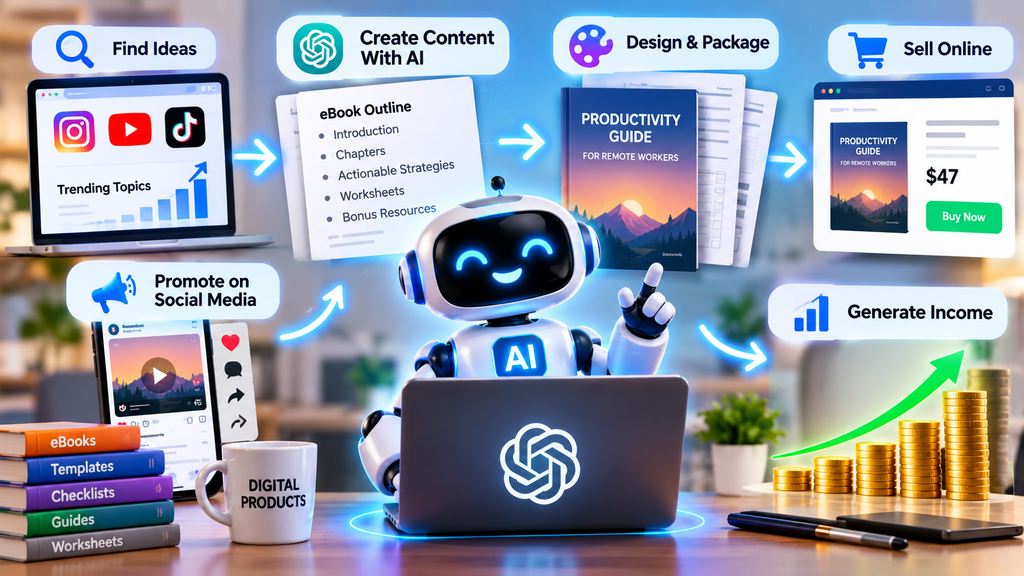
An AI-powered digital product business uses artificial intelligence to assist with different parts of the product-development and marketing process.
Instead of manually performing every task, a creator can use AI for activities such as:
- Finding potential product ideas
- Researching customer problems
- Defining a target audience
- Developing an eBook structure
- Creating chapter ideas
- Generating worksheets and exercises
- Improving written content
- Creating marketing copy
- Designing product assets
- Researching social media content
- Developing video scripts
- Automating product delivery
The important point is that AI does not automatically create a successful business. A digital product still needs to solve a genuine problem and provide enough value for someone to pay for it.
The source material makes a similar point, emphasizing that AI can significantly reduce the time involved in product creation, but creators still need to publish content, help their audience, and provide real value.
Step 1: Find a Digital Product Topic People Already Want
The first step is choosing a market or topic.
One strategy is to look for subjects that already receive attention online. For example, the source material uses productivity as an example and describes searching Instagram for productivity-related content. Videos in the example were receiving hundreds of thousands or millions of views, suggesting that productivity was attracting significant interest on the platform.
You do not necessarily need to invent a completely new category.
Instead, look for existing demand.
Potential digital product niches include:
- Productivity
- Personal organization
- Fitness
- Cooking
- Career development
- Remote work
- Personal finance education
- Study skills
- Business organization
- Content creation
- Social media marketing
- Freelancing
- Professional development
Another approach is to begin with something you already understand or enjoy. If you have knowledge of fitness, cooking, design, business, education, or another subject, that interest can become the starting point for a digital product.
The goal is not simply to select a popular topic. The better objective is to identify a specific problem within a topic.
For example, “productivity” is broad.
A more specific idea could be:
A Productivity Guide for Remote Workers Who Struggle With Distractions
This immediately defines the audience, problem, and potential product direction.
Step 2: Narrow Down Your Target Audience
A common mistake in digital product creation is attempting to create something for everyone.
A more focused audience makes it easier to understand what the customer actually needs.
Instead of:
“A productivity eBook for everyone”
you could create:
“A practical productivity system for remote employees who struggle to stay focused while working from home.”
The second concept gives you a clearer customer profile.
You can then identify:
- Their biggest frustrations
- Their daily challenges
- What solutions they have already tried
- What outcomes they want
- What prevents them from achieving those outcomes
- What type of information they would find useful
The source material describes using ChatGPT to turn a broad trend into a more specific eBook concept by identifying the target audience, pain points, emotional triggers, concepts, taglines, and potential titles.
This is one of the most useful applications of generative AI: moving from a vague idea toward a clearly defined product concept.
Step 3: Use AI to Develop the Product Concept
Once you have selected your audience and problem, AI can help organize the idea into a product.
For example, you could provide an AI tool with information about your audience and ask it to develop:
- Product title ideas
- A subtitle
- Chapter structure
- Learning objectives
- Practical exercises
- Checklists
- Worksheets
- Frequently asked questions
- Action steps
- Bonus resources
The source workflow describes turning the initial concept into a more refined “product builder prompt” before moving it into an AI product-building tool.
This step is important because the quality of the final product depends heavily on the quality of the initial concept.
A vague prompt often produces generic content.
A detailed prompt can specify the audience, problem, desired outcome, tone, structure, length, examples, and practical exercises.
Step 4: Create the eBook or PDF With AI
After the concept has been refined, an AI product builder can be used to create the initial product.
According to the source material, the demonstrated workflow generated an eBook structure containing an introduction, chapters, actionable strategies, and worksheets. The example claims that a complete PDF product could be created within minutes.
However, AI-generated content should not simply be published without review.
A better workflow is:
- Generate the initial draft.
- Review every section.
- Remove repetitive information.
- Check factual claims.
- Add original examples.
- Improve the instructions.
- Add practical exercises.
- Edit the language.
- Check formatting.
- Test the product from the customer’s perspective.
This human review is particularly important for products involving finance, health, legal information, education, or other areas where inaccurate information can create serious problems.
AI should accelerate production, not replace quality control.
Step 5: Make the Digital Product Look Professional
Creating the content is only part of the process.
Presentation also affects how customers perceive a digital product.
A useful PDF should have:
- A professional cover
- Clear headings
- Consistent typography
- Easy-to-read paragraphs
- Tables or checklists where appropriate
- Useful illustrations or graphics
- Page numbers
- Consistent spacing
- Practical worksheets
- A logical navigation structure
The source material describes using Canva to add a professional cover, graphics, and improved formatting to the AI-generated PDF.
You can also improve the product by creating a consistent visual identity.
For example, your cover, sales page, social media graphics, and downloadable PDF can all use similar fonts, layouts, and branding.
This creates a more recognizable product ecosystem.
Step 6: Create a Simple Sales System
After creating the product, you need a way for customers to purchase it.
A digital-product selling platform can potentially combine several functions, including:
- Product hosting
- Sales page creation
- Checkout
- Payment processing
- Digital delivery
- Customer communication
- Basic support
The source material describes uploading the eBook to Allen.store, entering basic product information and a price, and using the platform to create a sales page, checkout system, and email delivery process.
The advantage of such a setup is that the creator does not necessarily need to manually send every purchased file.
A customer can discover the product, complete the checkout process, and receive the digital product through the delivery system.
Step 7: Build a Simple Digital Product Funnel
A digital product can also become part of a larger customer journey.
The basic funnel described in the source material works like this:
Content → Free Resource → Relationship Building → Digital Product → Higher-Value Offer
For example, imagine you sell a $47 productivity eBook.
You might first publish free productivity tips on social media.
Someone discovers your content and downloads a free productivity checklist.
That free resource introduces them to your work.
Later, they may purchase your more comprehensive eBook.
After purchasing the eBook, an optional consultation or higher-value service can be offered to customers who need more personalized assistance.
The source material gives an example of redirecting an eBook buyer to a thank-you page containing a calendar for a 15-minute call, where a higher-priced program could potentially be discussed.
This illustrates an important principle:
A low-priced digital product does not always have to be the final product.
It can also introduce customers to additional services, courses, consulting, coaching, or premium resources.
Step 8: Use Social Media to Promote Your Digital Product
Creating a product is not enough.
People need to discover it.
Social media can be an important source of organic traffic for digital products.
The source material focuses on Instagram and describes researching high-performing productivity videos to identify content that already attracts significant engagement.
The idea is not to copy another creator’s content.
Instead, study what appears to be working and identify patterns.
For example, examine:
- The topic
- The opening hook
- Video structure
- Length
- Presentation style
- Questions being answered
- Audience pain points
- Comments and discussions
- Calls to action
You can then create an original piece of content addressing the same general customer problem from your own perspective.
Step 9: Use AI to Generate Original Content Ideas
AI can also help turn research into content ideas.
For example, if you identify a high-performing topic about remote-work productivity, you can ask AI to develop several original content angles.
These could include:
- “5 mistakes remote workers make every morning”
- “How to structure a distraction-free workday”
- “The 30-minute planning routine for remote workers”
- “Why your productivity system keeps failing”
- “How to organize your workday without working longer”
The source material describes an AI feature that analyzes high-performing Instagram content and generates a new version of a video script based on successful content patterns.
When using this approach, the objective should be inspiration and modeling, not plagiarism.
Your script should contain original wording, examples, experiences, explanations, and conclusions.
Step 10: Understand the Revenue Model
One reason digital products are attractive is that the same digital file can potentially be sold multiple times without manufacturing or shipping another physical item.
The source material provides a hypothetical revenue illustration based on a $47 eBook, several daily sales, and additional higher-ticket product sales. It also includes examples of reported earnings from individuals using the described system.
These numbers should be treated as examples rather than guaranteed outcomes.
Actual revenue depends on factors such as:
- Product quality
- Market demand
- Pricing
- Audience size
- Conversion rate
- Traffic
- Customer trust
- Marketing consistency
- Competition
- Platform fees
- Refunds
- Product-market fit
For example, a $27 product requires a different sales volume than a $97 product to reach the same revenue target.
Therefore, creators should focus on building a useful product and understanding their audience rather than assuming a particular income level will automatically occur.
How to Choose the Right Price for a Digital Product
Pricing should reflect the value, depth, and specificity of the product.
A short checklist may be inexpensive, while a detailed professional guide containing templates, worksheets, examples, and implementation systems can justify a higher price.
Before selecting a price, consider:
Product Depth
How much useful information does the customer receive?
Problem Severity
Does the product solve a minor inconvenience or a significant problem?
Specificity
A generic eBook may be perceived differently from a highly specialized guide designed for a clearly defined audience.
Bonuses
Templates, worksheets, checklists, calculators, examples, and additional resources can increase the practical value of the product.
Audience
Pricing expectations can vary considerably between different markets and customer groups.
What Makes an AI-Generated Digital Product Valuable?
AI can make content creation faster, but speed is not the same as value.
A strong digital product should ideally provide:
Specificity: It should solve a clearly defined problem.
Actionability: Customers should know what to do after reading it.
Organization: Information should be presented logically.
Originality: It should offer your own examples, frameworks, experiences, or useful interpretation.
Usability: Worksheets, checklists, templates, and practical exercises can make information easier to apply.
Accuracy: Important factual claims should be checked before publication.
The biggest opportunity with AI is therefore not simply producing more words.
It is producing a useful solution faster.
Common Mistakes to Avoid
Several mistakes can undermine an AI digital-product business.
1. Choosing a Topic Without Demand
A creator may spend hours creating a product that nobody is actively looking for.
Research the audience first.
2. Creating Generic AI Content
AI-generated text can sound repetitive when it lacks specific examples and original insights.
Add your own expertise and practical experience.
3. Publishing Without Editing
Always review AI-generated content before selling it.
4. Ignoring Product Design
A valuable product can still look unprofessional if the formatting is poor.
5. Focusing Only on the Product
Marketing is part of the business.
A great product with no traffic may generate very few sales.
6. Expecting Instant Income
The source material itself emphasizes that the system is not a “magic button” and that creators still need to post content, help people, and provide real value.
A Practical AI Digital Product Workflow
The complete process can be simplified into the following system:
1. Identify a market
Find a topic that already attracts attention.
2. Find a specific problem
Determine what the target audience actually needs help with.
3. Define the customer
Specify who the product is designed for.
4. Create the product concept
Use AI to develop the title, structure, chapters, exercises, and positioning.
5. Generate the first draft
Use an AI writing or product-building tool to accelerate production.
6. Edit and verify
Review the content, correct errors, improve examples, and add original material.
7. Design the PDF
Use a design platform to create professional formatting and visual presentation.
8. Create the sales page
Explain the problem, product benefits, contents, audience, and purchasing process.
9. Automate delivery
Set up a system that delivers the product after purchase.
10. Create free content
Publish useful social media content related to the product.
11. Build a funnel
Move interested users from free content toward the digital product and, where appropriate, additional services.
12. Improve continuously
Monitor customer questions, feedback, conversions, and content performance.
Can You Really Build a Digital Product in Minutes?
AI can dramatically reduce the time required for certain stages of digital product development. The source material demonstrates a workflow in which an initial idea is transformed into a structured digital product using AI tools within a short period.
However, creating a file and creating a successful product are two different things.
The first draft may be produced quickly.
The harder work is often understanding the customer, improving the content, verifying information, developing useful examples, creating an effective offer, building trust, and consistently marketing the product.
Therefore, AI should be viewed as a productivity system rather than a guaranteed money-making machine.
Final Thoughts
AI has lowered many of the technical barriers associated with creating digital products. A person with a useful idea can now use AI to research a niche, define an audience, structure an eBook, generate an initial draft, create supporting materials, prepare marketing content, and automate parts of the sales and delivery process.
The workflow described in the source material follows a simple principle: find existing demand, identify a specific problem, create a useful solution, package it professionally, and build a system for reaching potential customers.
The most important part, however, is value.
AI can help you create an eBook faster, but customers ultimately pay for useful information, practical solutions, convenience, clarity, and outcomes.
If you want to build a sustainable digital product business, focus less on producing content simply because AI makes it easy and more on understanding what your audience genuinely needs.
A simple digital product can be the starting point. From there, it can potentially develop into a broader business involving templates, courses, consulting, memberships, services, or other products.
The technology may make the process faster, but the fundamentals remain the same: solve a real problem, create something useful, communicate its value clearly, and consistently serve the audience you are trying to reach.


