

Yearly Savings Goals: How Much to Save Each Month

Saving money is one of the most important financial habits you can develop, especially when you want to start a new year with a clear plan. Whether you are building an emergency fund, preparing for a vacation, buying a new car, or working toward financial independence, setting a yearly savings goal can help you manage your money more effectively.
However, knowing how much to save can be confusing. You might want to save $1,000, $5,000, or even $10,000 in one year, but calculating the monthly amount required is often the first challenge. Without a clear plan, it is easy to postpone saving or spend money that could have gone toward your future goals.
The good news is that you do not need a complicated financial strategy to get started. By dividing your annual savings goal into smaller monthly contributions, you can create a manageable plan that fits your income and lifestyle.
This guide explains how much you should save each month to reach different yearly savings targets, how to create a practical savings budget, and which habits can help you stay consistent throughout the year.
Why Set a Yearly Savings Goal?
A yearly savings goal gives your money a clear purpose. Instead of saving whatever remains at the end of each month, you decide in advance how much you want to accumulate and when you want to reach your target.
This approach can make financial planning easier because you can divide a large goal into smaller, measurable steps.
For example, saving $1,000 in one year requires approximately $83.33 per month. Saving $10,000 in the same period requires approximately $833.33 per month. Although these goals require different levels of income and financial commitment, the planning process is similar.
A yearly savings target can help you:
- Build an emergency fund for unexpected expenses.
- Prepare for major purchases without relying entirely on credit.
- Save for travel, education, or home improvements.
- Improve your spending and budgeting habits.
- Reduce financial stress by preparing for future costs.
- Develop greater confidence in managing your money.
The most effective savings goal is one that reflects your actual financial situation. You do not need to choose the largest target to make meaningful progress. Even a modest amount saved consistently can strengthen your financial position over time.
How Much Should You Save Each Month?
The amount you should save depends on your yearly target, your income, your essential expenses, and your other financial responsibilities.
A simple way to calculate your monthly savings goal is to divide your annual target by 12.
Monthly savings target = Annual savings goal ÷ 12
For example, if your goal is to save $3,000 in one year, divide $3,000 by 12. The result is $250 per month.
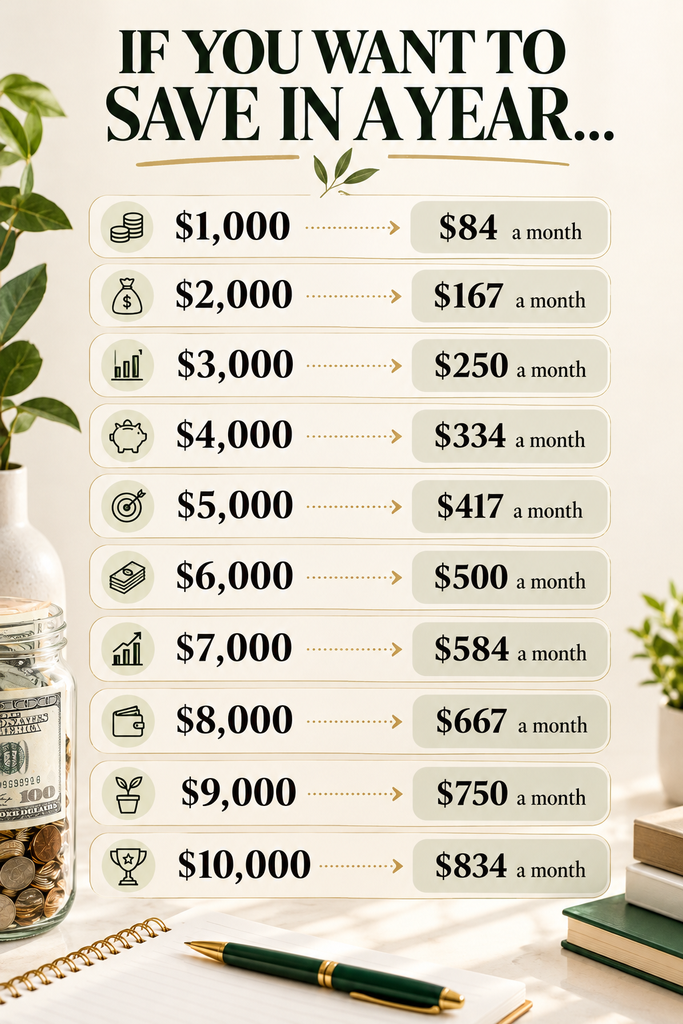
The following table shows the approximate monthly amounts needed to reach different annual savings goals.
| Annual savings goal | Approximate monthly savings |
|---|---|
| $1,000 | $83.33 |
| $2,000 | $166.67 |
| $3,000 | $250 |
| $4,000 | $333.33 |
| $5,000 | $416.67 |
| $6,000 | $500 |
| $7,000 | $583.33 |
| $8,000 | $666.67 |
| $9,000 | $750 |
| $10,000 | $833.33 |
These amounts assume 12 equal monthly contributions and exclude interest, investment returns, fees, and taxes.
If you prefer to use whole-dollar amounts, round the monthly contribution up. For example, saving $84 per month would give you $1,008 after 12 months, while saving $834 per month would give you $10,008.
Rounding up slightly creates a small cushion and makes the target easier to follow without complicated calculations.
1. Set a Savings Goal That Matches Your Income
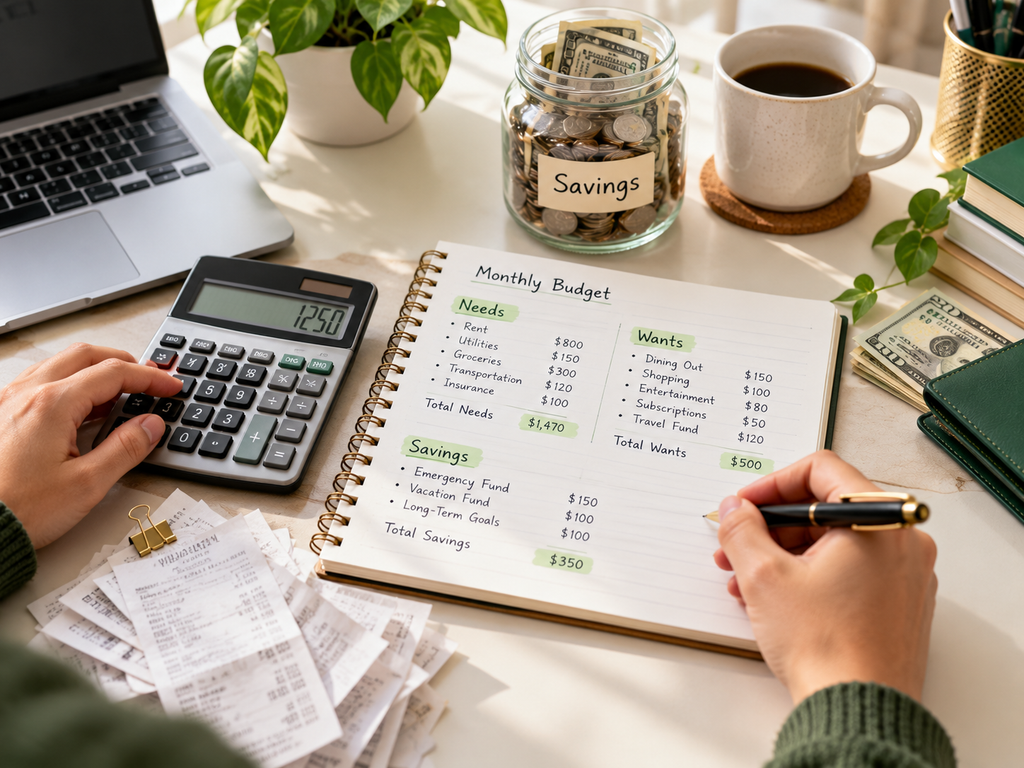
Before choosing a target, review your monthly income and essential expenses. Your savings plan should be based on the money you can realistically set aside rather than an amount that looks impressive on paper.
Start by calculating your take-home income after taxes and other payroll deductions. Include reliable additional earnings, such as regular freelance work or business income, but avoid depending on payments that are uncertain.
Next, list your essential expenses, including:
- Rent or mortgage payments.
- Groceries and household supplies.
- Electricity, water, and other utilities.
- Transportation costs.
- Healthcare and insurance.
- Minimum required debt payments.
- Education and family responsibilities.
Subtract these expenses from your available income. Then account for other necessary spending and determine how much remains for savings.
For example, if you earn $2,500 per month after taxes and your essential expenses total $1,800, you have $700 remaining before other flexible expenses and financial priorities.
Saving $500 per month might be possible if your remaining costs allow it. Saving $833.33 would require additional changes, more income, existing savings, or a different timeline.
The important point is to choose a goal that supports your financial stability instead of creating unnecessary pressure.
2. Create a Monthly Savings Budget
A monthly budget helps you decide how much money should go toward expenses, savings, and other financial obligations.
Without a budget, it is easy to underestimate small purchases and recurring payments. These expenses can gradually reduce the amount available for savings.
Begin by separating your spending into three broad categories.
Essential Expenses
These are necessary costs such as housing, groceries, utilities, transportation, healthcare, and required debt payments.
Flexible Expenses
These include dining out, entertainment, shopping, subscriptions, and other purchases that may be adjusted when necessary.
Savings and Financial Goals
This category includes emergency savings, planned purchases, debt repayment beyond required minimums, and other financial priorities.
Once you understand your spending, assign a realistic amount to each category. If your savings target is too high for your current budget, reduce the goal or extend the deadline rather than neglecting essential expenses.
You can also review your budget each month. If your income increases or an expense disappears, redirect some of the additional money toward savings.
A budget is not meant to restrict every decision. It helps you make intentional choices and ensures that your savings goals remain part of your financial routine.
3. Use the 50/30/20 Budgeting Rule
The 50/30/20 rule is a commonly used budgeting framework that divides take-home income into three categories:
- 50% for needs: Housing, groceries, utilities, transportation, and other essential expenses.
- 30% for wants: Entertainment, hobbies, restaurant meals, and nonessential purchases.
- 20% for savings and debt goals: Savings contributions and additional debt repayment.
For example, if your monthly take-home income is $3,000, this framework would initially allocate $1,500 to needs, $900 to wants, and $600 to savings and debt goals.
At this savings rate, you could set aside $7,200 over 12 months if you consistently save $600 each month.
However, the 50/30/20 rule is a guideline rather than a strict requirement. If your housing costs are high or you support a family, you may need to allocate more than 50% to essential expenses.
Likewise, if your income is relatively high and your expenses are manageable, you might be able to save more than 20%.
Use the framework as a starting point and adjust it according to your circumstances.
4. Choose the Right Savings Goal for Your Priorities
Not every savings goal serves the same purpose. Before deciding how much money to accumulate, identify what you want to achieve with it.
Save $1,000 for a Starter Emergency Fund
A $1,000 target can be a useful starting point for someone who has little or no emergency savings. It may help cover a smaller unexpected bill, although it will not be sufficient for every household or emergency.
To save $1,000 in one year, set aside approximately $84 per month.
Save $3,000 for Planned Expenses
A $3,000 fund could help cover travel, education expenses, home improvements, or other planned purchases.
Saving $250 per month for 12 months would give you $3,000 before interest and fees.
Save $5,000 for a Larger Financial Goal
A $5,000 target may help you prepare for a major purchase, build a more substantial cash reserve, or cover a combination of upcoming expenses.
You would need to save approximately $417 per month to reach this target within one year.
Save $10,000 for a Major Financial Milestone
A $10,000 savings goal requires more substantial monthly contributions, but it can be useful for people with sufficient income and manageable expenses.
Saving approximately $834 per month would produce $10,008 over 12 months.
Before committing to this target, make sure the required contribution fits your budget. If it does not, you can extend the deadline or start with a smaller goal and increase it over time.
5. Build an Emergency Fund Before Unexpected Expenses Occur
An emergency fund is money reserved for unplanned costs such as urgent repairs, medical expenses, or temporary income disruptions.
Without accessible savings, an unexpected expense can force you to use a credit card or take out a loan. This may increase financial pressure, particularly when borrowing costs are high.
If you do not have an emergency fund, begin with a manageable initial target. You might start by saving $500 or $1,000, depending on your income and essential expenses.
Over time, a commonly used guideline is to work toward three to six months of essential living expenses. The appropriate amount varies according to employment stability, family responsibilities, insurance coverage, and other financial circumstances.
Keep emergency money in an appropriately accessible, low-risk account rather than relying on investments that can lose value when you need to withdraw the funds.
If you already have expensive debt, consider balancing debt repayment with a reasonable emergency reserve. This can help you avoid borrowing again when an unexpected bill arises.
6. Reduce Unnecessary Expenses to Save More
You may not need a significant income increase to improve your savings rate. In some cases, reviewing existing spending can reveal opportunities to set aside more money each month.
Start by checking your bank statements, digital wallet transactions, and receipts. Look for purchases that occur frequently but provide limited value.
Consider the following strategies.
Reduce restaurant spending. Preparing meals at home more often can help lower food costs. Planning meals also makes grocery shopping more organized.
Cancel unused subscriptions. Review streaming services, memberships, and paid applications. Keep the services you genuinely use and remove unnecessary recurring payments.
Avoid impulse purchases. Introduce a 24-hour waiting period before buying nonessential items. For larger purchases, allow yourself more time to compare options.
Plan grocery shopping. Create a shopping list and check what you already have before visiting the supermarket.
Compare prices. Consider unit prices, durability, and quality rather than choosing a product simply because it is discounted.
Set a monthly entertainment limit. Decide how much you can comfortably spend on restaurants, hobbies, and leisure activities without affecting your savings target.
For example, reducing unnecessary spending by $25 per week could free up approximately $1,300 over a year if you maintain the reduction throughout all 52 weeks.
You do not need to eliminate every enjoyable activity. Focus on expenses that can be reduced without compromising your health, safety, or quality of life.
7. Automate Your Monthly Savings
One of the easiest ways to build a consistent savings habit is to automate contributions.
If your bank supports scheduled transfers, arrange for a suitable amount to move into a separate savings account after payday. This allows you to save regularly without having to make the same decision every month.
For example, you could schedule a $250 transfer each month to reach a $3,000 annual goal.
Automation works best when the contribution is realistic. Before scheduling a transfer, account for upcoming bills, groceries, transportation, and required debt payments.
If your income varies, you can set a smaller regular contribution and add extra money during months when you earn more.
Keep savings separate from everyday spending funds so that you can see your progress clearly.
Check account fees, withdrawal restrictions, and applicable protections before choosing where to keep your money.
8. Track Your Savings Progress Every Month
Tracking helps you determine whether your savings plan is working and whether you need to make adjustments.
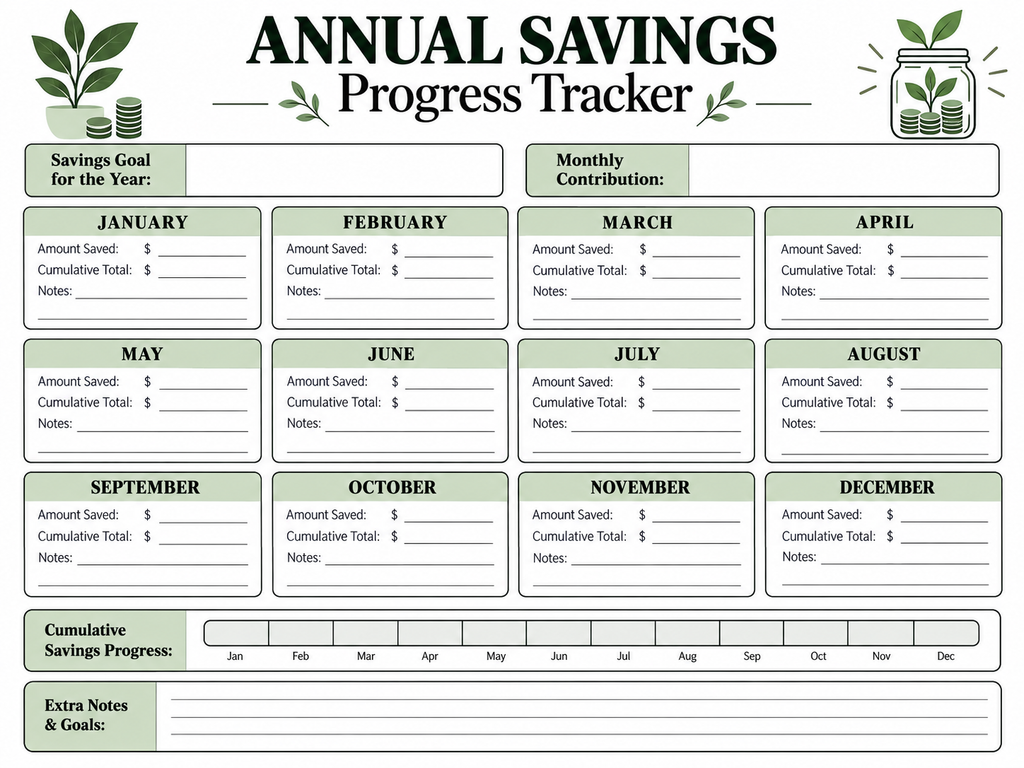
You can use a spreadsheet, a budgeting application, a notebook, or a printable annual savings tracker.
Record four basic details:
- Your annual savings target.
- Your planned monthly contribution.
- Your actual savings contribution.
- Your current accumulated balance.
For example, if your annual goal is $3,000, you can use the following monthly milestones.
| Month | Monthly contribution | Cumulative savings |
|---|---|---|
| January | $250 | $250 |
| February | $250 | $500 |
| March | $250 | $750 |
| April | $250 | $1,000 |
| May | $250 | $1,250 |
| June | $250 | $1,500 |
| July | $250 | $1,750 |
| August | $250 | $2,000 |
| September | $250 | $2,250 |
| October | $250 | $2,500 |
| November | $250 | $2,750 |
| December | $250 | $3,000 |
This example assumes consistent contributions and excludes interest.
Review your progress at the end of each month. If you are behind, identify the reason before changing your target. An unexpected expense may require a temporary adjustment, while repeated overspending might indicate that your budget needs to be revised.
A tracker is useful because it turns your goal into a series of measurable steps. You can see how much you have saved and how much remains.
9. Prepare for Irregular and Annual Expenses
A monthly budget can become difficult to maintain when large bills arrive unexpectedly. Annual insurance payments, school fees, vehicle maintenance, holiday travel, and property repairs can all affect your savings progress.
Some of these expenses are predictable, even if they occur only once or twice a year.
Estimate the likely cost and divide it into monthly contributions. For example, if you expect a $600 annual bill in 12 months, setting aside $50 per month will help you prepare for it.
Create separate savings categories for planned expenses and emergency costs. This makes it easier to distinguish money reserved for an upcoming payment from money intended for unexpected situations.
If a bill is due sooner, calculate the amount you need to save each week or month and adjust your spending plan accordingly.
Preparing for irregular expenses can help protect your annual savings goal from being disrupted by predictable costs.
10. Increase Your Savings With Additional Income
If your monthly budget does not leave enough money to reach your desired target, additional income may help.
Depending on your skills, schedule, and circumstances, you could consider freelance work, tutoring, consulting, temporary assignments, or selling unused items in good condition.
You might also explore opportunities to develop skills that could improve your longer-term earning potential.
However, additional income should be calculated carefully. Freelance work and side businesses may involve platform fees, transportation costs, supplies, taxes, or other expenses.
Count only the money available after these costs when calculating your savings progress.
Avoid schemes that promise guaranteed high returns or require suspicious upfront payments. You do not need to take unnecessary financial risks to improve your savings rate.
If extra income becomes available, consider dividing it between savings, essential expenses, and debt repayment according to your priorities.
11. Make Your Savings Habit Sustainable
A successful savings plan should continue beyond the first few months. Rather than making drastic changes that become difficult to maintain, focus on developing a routine that fits your lifestyle.
Start with a manageable monthly contribution. Once you have maintained it for several months, consider increasing the amount if your finances allow.
You can also review your savings goal when your income changes. A salary increase, completed loan payment, or reduced household expense may create an opportunity to save more.
At the same time, do not treat one missed contribution as a failure. If an unexpected bill interrupts your plan, adjust the schedule and continue when your finances permit.
The purpose of saving is to improve financial security over time. Consistency, flexibility, and realistic expectations are more useful than following an inflexible target that does not reflect your circumstances.
Common Savings Mistakes to Avoid
Even a well-planned savings goal can become difficult to achieve when you overlook important financial details.
Setting an Unrealistic Monthly Target
Choose a contribution that fits your available income. If saving $833 per month is not affordable, select a smaller target or extend the deadline.
Forgetting to Account for Essential Expenses
Do not neglect rent, food, healthcare, utilities, or required debt payments to reach a savings milestone.
Ignoring Small Purchases
Frequent discretionary purchases can add up. Review your spending patterns and identify changes that would make a meaningful difference.
Failing to Plan for Annual Bills
Predictable expenses can disrupt your budget when you do not prepare for them. Create separate monthly contributions for upcoming costs.
Withdrawing Savings for Routine Spending
Keep your savings separate from everyday spending money and use it according to the purpose you originally assigned.
Expecting Immediate Results
Financial progress usually develops over time. Focus on your monthly contribution and review your progress regularly instead of expecting a major change after a few weeks.
Frequently Asked Questions
How much should I save each month to reach $1,000 in a year?
You need to save approximately $83.33 per month to accumulate $1,000 over 12 months, excluding interest. Saving $84 per month would give you $1,008.
How much should I save monthly to reach $5,000?
To save $5,000 in one year, you need to contribute approximately $416.67 per month. Saving $417 monthly would produce $5,004 over 12 months.
How much money should I save monthly to reach $10,000?
You need to save approximately $833.33 per month to reach $10,000 in one year. Saving $834 per month would give you $10,008 before interest and fees.
What is the easiest way to calculate a monthly savings goal?
Divide your annual savings target by 12. If you want to save $2,400 in one year, divide $2,400 by 12 to get a monthly contribution of $200.
What percentage of my income should I save?
The 50/30/20 budgeting framework suggests allocating 20% of take-home income to savings and debt goals. However, the appropriate percentage depends on your income, essential expenses, debts, and financial priorities.
Is it better to save monthly or weekly?
Both methods can work. Monthly transfers may be convenient for salaried workers, while weekly contributions may be easier for people who receive income more frequently. Choose the schedule that matches your cash flow.
Should I pay off debt or save money first?
Your approach depends on interest rates, existing emergency savings, and financial obligations. Paying down high-interest debt can reduce borrowing costs, but keeping some accessible savings may help prevent additional borrowing when unexpected expenses occur.
What if I cannot reach my annual savings goal?
Review your income and expenses, identify realistic spending reductions, and consider increasing income if practical. If the original target is not affordable, reduce the amount or extend the timeline rather than compromising essential needs.
Conclusion
Setting a yearly savings goal can help you organize your finances, prepare for future expenses, and develop stronger money management habits. Whether your target is $1,000, $5,000, or $10,000, the process begins with calculating how much you need to save each month.
Create a realistic budget, choose a monthly contribution that fits your income, reduce unnecessary expenses where practical, and track your progress throughout the year. Consider automating transfers and preparing separately for annual bills so that your savings plan remains consistent.
Most importantly, remember that your savings goal should support your financial well-being rather than create unnecessary pressure. If a target is too ambitious for your current circumstances, adjust it and continue building your savings over time.
With a clear plan and consistent contributions, you can make steady progress toward your financial goals and enter the next year with greater financial confidence.


